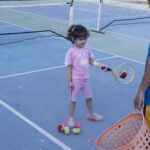
Why Starting Sports at Age 3 Gives Your Child a Lifetime Advantage — And Where to Begin in Karachi
Every parent wants the best for their
A school PE period used to mean one thing: a whistle, a ball, and forty minutes of loosely supervised running around. That model is changing fast in Karachi. Increasingly, school administrators are asking a different question — not “how do we fill the sports period” but “how do we make it count.” The answer a growing number of them are arriving at is structured, professionally coached programmes brought directly onto campus.
This isn’t a trend driven by nostalgia for a fitter generation. It’s driven by parents who now expect the same rigour from a school’s sports curriculum that they expect from its academics, and by administrators who’ve realised that untrained supervision produces neither skill nor safety. Tennis and padel, taught properly, do something a generic games period simply can’t: they build coordination, discipline, and confidence that carries into the classroom.
Most school sports periods are run by well-meaning staff who are not trained coaches. Nothing wrong with that in principle — except when the goal shifts from supervised play to actual skill development. A child who swings a racket incorrectly for two years doesn’t just fail to improve; they build habits that are genuinely harder to unlearn later. This is precisely the gap in-school programmes from Baseline Tennis Academy are designed to close.
We bring PTR-certified coaching — the same structured methodology used in our DHA academy — directly to school campuses. Founded by Farhan Wahid, a PTR-certified coach and former Pakistan No. 2 Junior, Baseline Tennis Academy applies internationally recognised teaching progressions rather than improvised drills. That distinction matters more than most schools realise until they see it in action: children don’t just get “activity,” they get instruction that compounds week over week.
Not every sport translates well to a school setting. Tennis and padel both do, for practical reasons. They require relatively little space per student compared to full-field team sports, they scale easily from complete beginners to advanced players within the same session, and — critically — they’re sports children can genuinely continue playing for the rest of their lives, unlike many activities that stop the day school ends.
Padel in particular has found unexpected traction with schools that have limited court space, since padel courts are smaller than tennis courts and the enclosed format makes the game far more forgiving for first-time players. A child who’s never held a racket can be rallying within a single session — something that rarely happens in traditional tennis on day one. For administrators trying to introduce a new sport without a steep early dropout rate, that’s a meaningful advantage.
A well-structured in-school programme isn’t a scaled-down version of academy classes — it’s built around the realities of a school calendar and campus. That means sessions that fit within existing PE periods, coaches who track individual student progress across the term rather than treating every class as a fresh start, and curricula that align with age and skill bands rather than grouping an entire grade into one session regardless of ability.
Just as important is what happens off the court: schools want visibility into what their investment is producing. That means term-end progress updates, clear skill benchmarks, and coaching staff who communicate directly with PE department heads — not a vendor who shows up, runs a session, and disappears until the next invoice.
The strongest argument for in-school coaching isn’t really about the sport itself — it’s about what structured physical training does for a child’s broader development. Coordination, focus, and the ability to absorb correction and apply it are skills that transfer directly into academic performance. Children who learn to handle competitive pressure on a tennis or padel court tend to handle exam pressure and social pressure with more composure too. Schools that have introduced professional coaching aren’t just adding a sport to the timetable; they’re adding a training ground for resilience.
There’s also a practical continuity benefit for families. A child introduced to tennis or padel through their school programme has an obvious next step: continuing in structured classes at Baseline’s DHA facility, where the same coaching philosophy carries through outside term time. Parents increasingly appreciate that consistency — the coach their child knows from school is the same standard they’ll find in kids tennis DHA classes on weekends.
If you’re part of a school administration in Karachi considering how to elevate your sports curriculum — or a parent who wants to advocate for better coaching at your child’s school — Baseline Tennis Academy’s in-school programmes are built exactly for this purpose. We design the curriculum around your campus, your calendar, and your students’ skill levels, with the same PTR-certified standards that define our tennis classes Karachi families already trust.
Get in touch through baselinetennisacademy.pk or message us on WhatsApp to discuss bringing professional tennis and padel coaching to your school this term.

Every parent wants the best for their
So your child has shown interest in
If you’ve been hearing the word “pickleball”
Every parent in Karachi wants to give
Our experienced coaches provide professional training programs tailored to players of all ages and skill levels. We are committed to helping every student grow with confidence while delivering a fun, supportive, and high-quality learning experience.