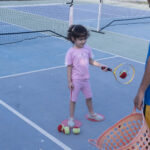
Why Starting Sports at Age 3 Gives Your Child a Lifetime Advantage — And Where to Begin in Karachi
Every parent wants the best for their

Most beginners in padel can hit the ball within ten minutes. What takes longer is knowing why you just lost a point you thought you won, or why your partner is shouting “mine!” from the other side of the court. Padel rewards players who understand the structure of the game, and that structure is simpler than it looks.
Think of this as the guide to keep in your kit bag: how a match is scored, the handful of rules that catch out new players, and the strategy that wins points at beginner and intermediate level. Padel Karachi players are picking it up fast, and the ones who improve quickest are the ones who learn the logic early.
Padel is always played in doubles, and scoring borrows from tennis. Points run 15, 30, 40, then game. Games build into sets, and the first side to win six games (with a two-game margin) takes the set. A match is typically the best of three sets. If a set reaches six games each, a tiebreak usually decides it.
The one variation worth knowing about is what happens at 40-40. Some matches play traditional deuce, where you must win two points in a row. Many recreational games use a “golden point” instead: one deciding point, and the receiving team chooses which player returns serve. Always ask which format is being used before you start, because it changes how you manage tight games. Golden point rewards the team that stays calm under pressure.
A few rules cause most of the arguments in a new player’s first weeks.
The serve is underarm. You bounce the ball first, then strike it at or below waist height, and it must land in the diagonal service box. This is the opposite of a tennis serve, and it takes the pressure off beginners, since power is not the point.
After the serve bounces, the ball may hit the glass or mesh and still be played. This is where padel becomes its own sport: a ball that bounces on your side and then rebounds off your back wall is still live, and you can return it.
However, you may not let the ball bounce twice on your side. And a ball you hit must bounce on the opponents’ side of the court before it touches a wall or fence. If it hits the glass first, you lose the point. The same applies to the net: touching it with your body or racket costs the point.
The central strategic idea in padel is simple: the team at the net holds the advantage. Standing close to the net, you can volley the ball down and angle it away from defenders. Standing at the back, you are reacting.
Almost every tactic in the game is about earning the net. When your opponents are at the net and you are at the back, your goal is to move them off it. The most reliable tool is the lob, a high, deep ball that pushes them back and lets you advance. Beginners are tempted to hit hard at the net players, and it rarely works; patience wins here.
Padel punishes partners who play like singles players. The strongest beginner habit you can build is to move together: when one player steps forward, the other follows, and when one gets pushed back, so does the other. The gap down the middle is the weak point on every court, and the clearest way to close it is communication. Call “mine” or “yours” early and loudly.
New players treat the glass as an obstacle. Experienced players treat it as a second chance. When a ball is hit deep past you, let it come off the back wall, reset your feet, and return it in a controlled way. Do not chase it with a swing; give it space.

Once you are comfortable, you can start using the walls offensively. Shots like the bandeja, a controlled overhead hit with slice, keep your team at the net without the risk of smashing the ball out of the court. A smash that bounces back over the fence is a point you can still lose, so shape and placement matter more than power in your first months.
Padel looks easy because the rules are forgiving, and that is why bad habits set in quickly: swinging too hard, staying at the back, ignoring your partner. A few structured sessions fix this faster than months of casual games.
At Baseline Tennis Academy in DHA, our padel coaching is led by Farhan Wahid, a PTR-certified coach and former Pakistan No. 2 Junior, so you learn scoring, positioning and shot selection from the start. Whether you are a complete beginner or a tennis player moving across, we can help you play with confidence. For current availability, visit baselinetennisacademy.pk or message us on WhatsApp to book your session.
Note: golden point and tiebreak formats vary between groups, so confirm the format before you play.