Why Starting Sports at Age 3 Gives Your Child a Lifetime Advantage — And Where to Begin in Karachi
Every parent wants the best for their

Every few weeks, a parent watches their child rally cleanly for ten minutes and asks the same question: should we sign up for a tournament? It’s a fair question, and a harder one to answer than it sounds — because readiness for competition has almost nothing to do with how good a child looks hitting balls in a lesson.
A child can have a clean forehand and still fall apart the moment a point actually counts. Another child can have a rough, unpolished swing and handle pressure like it’s nothing. Competitive readiness is a different skill than stroke production, and conflating the two is the single biggest reason Karachi parents either push their kids into tournaments too early, or hold them back long after they were ready.
At Baseline Tennis Academy in DHA, we get asked this constantly, so here’s how we actually think about it — not as a checklist, but as a set of signals worth watching for.
This is the part most parents already track instinctively: can your child sustain a rally, serve with some consistency, move to the ball instead of waiting for it, and recover position after a shot? These are baseline mechanical requirements, and they’re relatively easy for a coach to assess in a single session. If your child is enrolled in tennis classes in Karachi and has been training consistently for six months to a year, they’ve likely cleared this bar already.
What technical readiness does not tell you is whether a child is ready to lose a point, absorb a bad line call, or keep playing their game after falling behind 0–3 in a set. That’s a separate, and honestly more important, question.
We watch for this specifically in practice: what does a child do immediately after missing an easy shot? A child who’s ready to compete resets quickly — frustrated for a second, then focused on the next ball. A child who isn’t ready yet tends to spiral: the next three shots get worse, not because their technique broke down, but because their head did.
This isn’t a flaw to fix before competing — it’s actually something children learn through low-pressure competitive exposure, not before it. Which is why we don’t wait for emotional perfection before introducing match play. We introduce it gradually, in controlled settings, specifically so kids build this resilience while the stakes are still small.
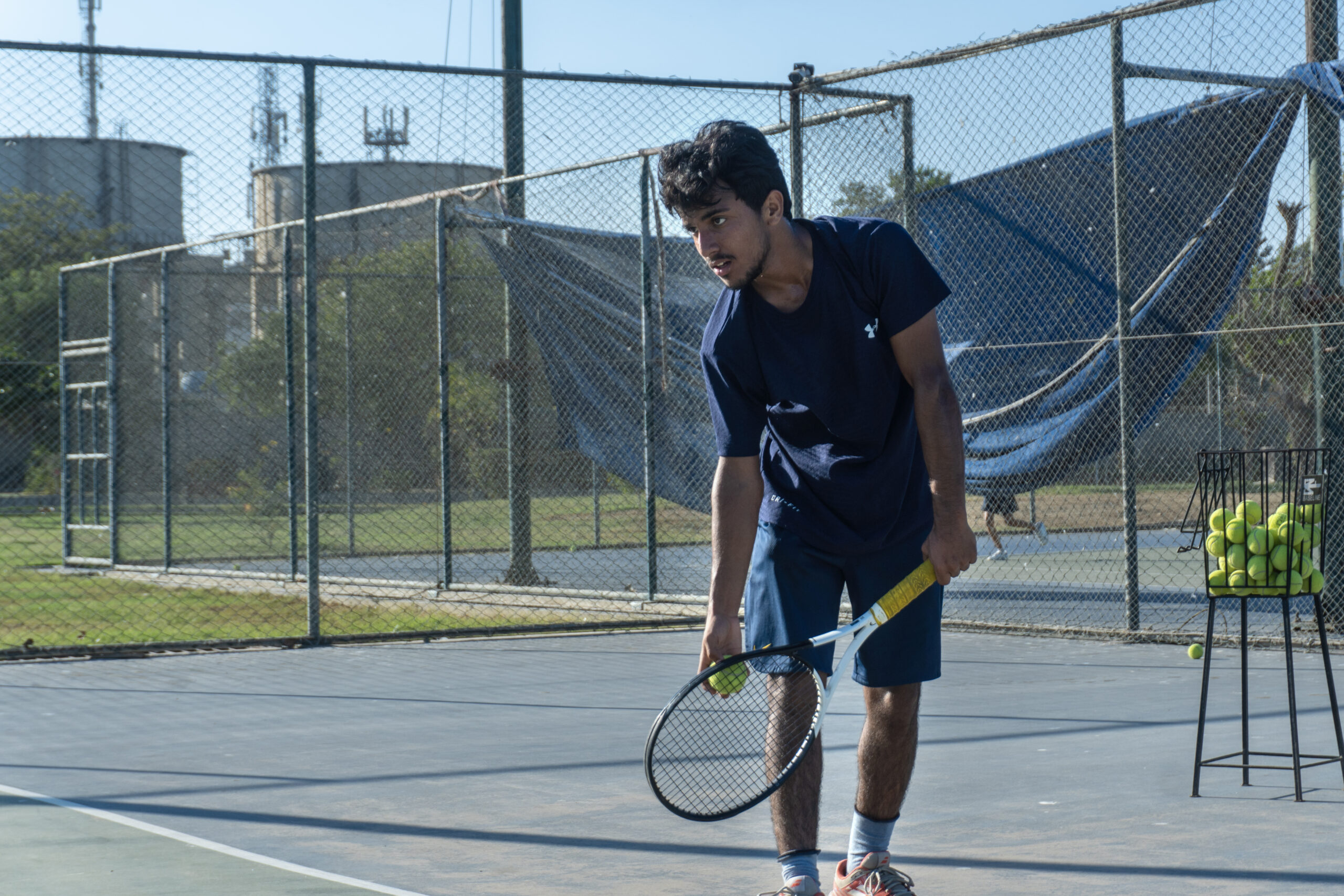
We don’t move a junior straight from group drills to a tournament draw. There’s a middle stage that matters more than most academies admit: supervised practice matches against training partners of a similar level, scored and played under real rules, but with a coach present to debrief afterward. This is where a child learns to serve under pressure, to make a line call fairly, and to finish a set they’re losing instead of mentally checking out.
Every junior’s path through this stage is shaped individually. As a PTR-certified coach and former Pakistan No. 2 Junior, I built our junior programme around exactly this gap — the space between “can hit the ball well” and “can compete and still enjoy it” — because it’s the stage most kids in Karachi skip entirely, and it’s the one that determines whether their first real tournament is a confidence builder or a bad memory.
A few concrete markers we look for before recommending a child’s first tournament: they can complete a full practice set without a coach intervening; they ask to play matches rather than only wanting drills; they can describe what went wrong in a lost point without dissolving into frustration; and they show up wanting to compete, not because a parent wants it for them. That last one matters more than people expect — kids who are pushed into competition before they’ve asked for it tend to burn out on the sport within a year, while kids who initiate it usually stick with it.
Once a child does start playing matches, the parent’s job changes more than the child’s does. The most useful thing you can do courtside is almost nothing — no coaching from the sidelines, no visible reaction to bad points, no post-match breakdown of every mistake. Let the coach handle the technical and tactical feedback. Your job is to be the calm, steady presence that makes the result, win or lose, feel unremarkable to come home to.
This is a hard shift for a lot of parents, especially ones who are invested and paying close attention. But it’s consistently the difference between kids who keep competing for years and kids who quit within a season.
There’s no universal age or skill level at which a child becomes “ready” for competitive junior tennis in Karachi — it depends entirely on the individual child, and the only way to know is to have someone who trains kids for a living actually watch them play. If you’re wondering whether your child is close, that’s exactly the conversation worth having with a coach before entering anything.
Visit baselinetennisacademy.pk or message us on WhatsApp to book an assessment, and we’ll tell you honestly where your child stands — whether that means their first tournament this season, or another few months building the foundation first.